

Rev. Dr. Drew Hart speaks to “Healing the Wounds of Anti-Blackness
by Jacqulyne Abe and S. Hale
On a warm Friday evening, September 26 at Roanoke College Rev. Dr. Drew G.I Hart stepped onto the podium in Wortmann Ballroom to share what was not a sermon in the traditional sense, but an incredibly in-depth lecture that spoke deeply to the case for reparations and “Healing the Wounds of Anti-Blackness.”
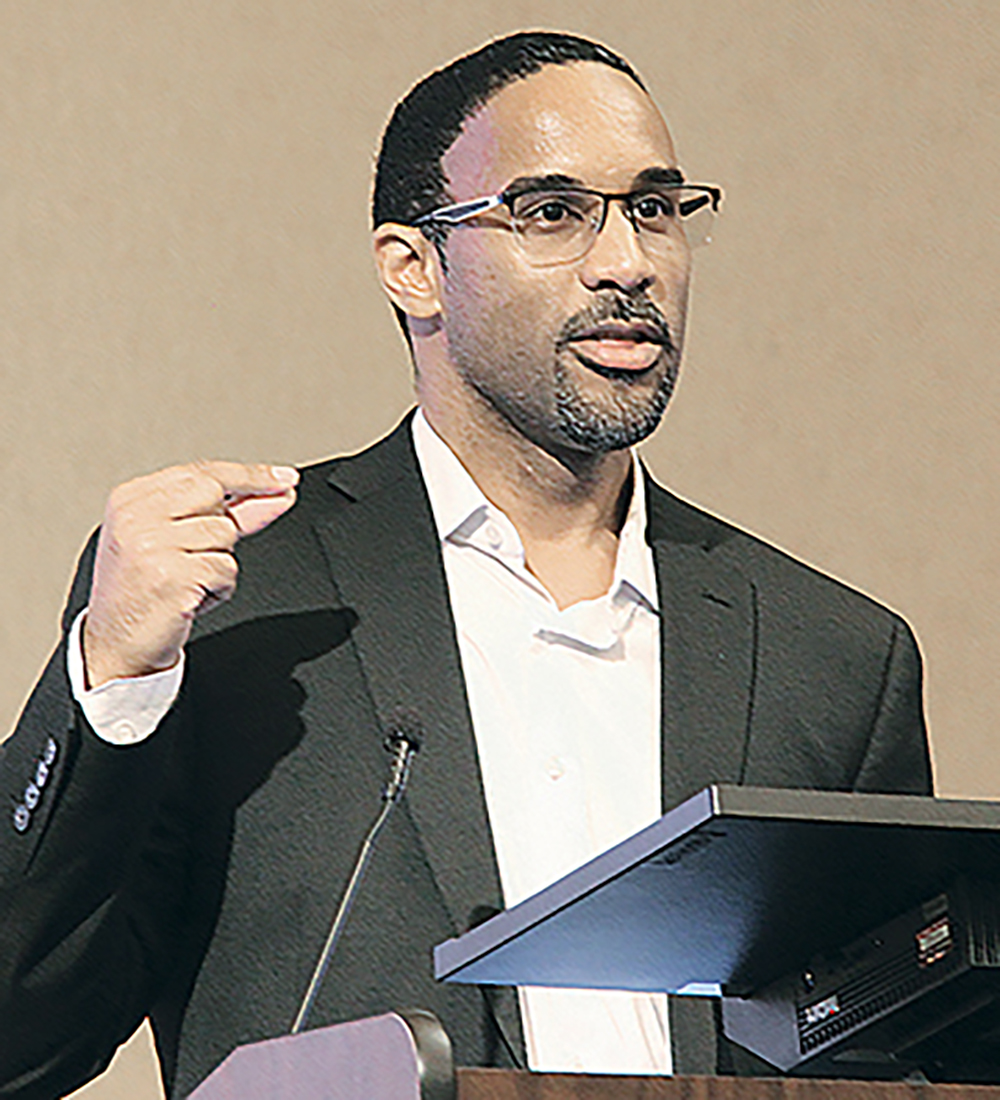
The event was co-sponsored by Roanoke College’s Center for Studying Structures of Race headed by founding director professor Jesse Bucher, the Roanoke Reparations Group and the Central Church of the Brethren.
Dr. Hart opened with a parable well-known to many Christians. It was the story of a man, beaten and left half-dead on the side of the road who was in desperate need of help. A priest passed by and chose another path. A Levite, (member of the Hebrew tribe of Levi) saw the man but also did nothing. Along came a Samaritan, a member of a group known to be loathed and marginalized during that era. He stopped moved by the man’s wounds, paid for his lodging and medical care and ensured the man that he would recover. This story of neglect and lack of love for your neighbor (the Jew and the Samaritan) was an analogy focusing on Christians, the church, the pursuit of healing and racial justice.
“I’m not convinced that the real challenge about the reasons why we don’t do the work of reparations has to do with all the arguments that are often brought up,” Dr. Hart asserted. “I think fundamentally there’s some question regarding people’s willingness to love Black people,” he said, turning up the heat.
Pressing further, regarding his case for reparations, he suggested that, “Not merely financial compensation, but a holistic response to centuries of racial violence, economic theft, and cultural erasure,” is imperative to the path that leads to healing the wounds of four hundred years of systemic oppression and it’s continuation thereof. “The point is, the harm has never stopped, He said.
Dr. Hart reminded the sizable and unassuming crowd that reparations were not a foreign concept to America and cited several precedents such as the formal apologies and financial compensation to Japanese Americans during World War II, the Native American tribes who have received limited restitution through land settlements and federal recognition of historical harms, though far from adequate.
After the Civil War, some Union states compensated slaveholders, not to the formerly enslaved, but to those who had lost property. Hart also pointed to the billions of dollars allocated to families’ of 9/11 victims who received compensation funds – all examples of reparations allocated in the past.
“One of the many reasons Black Americans have yet to receive meaningful repair is because White Christian Americans have repeatedly rejected Jesus’s command to love,” he said and paused, letting the weight of the words settle on the unassuming crowd. “To love your wounded neighbor, not in theory, but in practice, is the heart of the gospel. Yet for centuries, this nation has refused to fully love its Black neighbor. It has turned away from the rawness of Black grief, the depth of Black resilience, and the sacredness of Black life.”
“White America needs to understand that reparations are not about paternalistic charity but about healing for yourselves, because White supremacy has distorted and wounded your own (Caucasians) humanity throughout centuries.”
“Go and Do Likewise,” Reparations in action
Dr. Hart’s voice echoed through the conference room as he returned to the parable of the Good Samaritan. He talked about how Jesus intentionally chose the Samaritan, often seen as unclean and defiling true religion, to model neighborly love, forcing his followers to confront their biases and extend care to those historically mistreated. “This Samaritan,” he said, “crossed ethnic and religious hostility to embody the love of neighbor. In this story, love is not purely sentimental; it is compassion, solidarity, and action that restores dignity across social divisions. It reframes neighborly love not as sentiment, but as sacrificial solidarity.”
“The Samaritan didn’t just bandage wounds,” Hart explained. “He wrote a blank check. He paid for full recovery. He loved until the man could heal and thrive.” The Samaritan’s actions modeled a love that demands proximity, sacrifice and repair. Noting the profound implications for reparations, Dr. Hart said “The Samaritan did not cause the harm. He did not benefit from the robbery. Yet love compelled him to pay for full recovery and to act by paying for full recovery, not partial relief.”
After telling the story to a person questioning him, Jesus asked the man, “Which of the three men was a neighbor?” The questioner replied, “the one who showed mercy.” And Jesus answered, “Go and do likewise.”
The word of Jesus still resonates today, Dr. Hart said, “Go and do likewise. Not just in theory, but in practice. Not just in sermons, but in budgets, policies, and relationships.” Dr. Hart then posed the question: “What if any generation of white Christians, from slavery to the present, had taken this parable seriously? What if they had responded to centuries of Black suffering with restorative love? Where might we be today?”
Toward the Beloved Community: Future Possibilities
He compared this with white America’s response to the intergenerational pillage of Black life. Dr. Hart reminded his audience that the benefits of racial harm—land, wealth access and opportunity—have been passed down intergenerationally. “The refrain of ‘I didn’t do it’,” he said, “does not release us.
The implications are clear: Reparations require crossing the boundaries this country has drawn, and loving Black people means closing the gap between moral and restorative action. “If you refuse to love beyond financial calculation, beyond guilt, then you refuse the gospel itself.” He argued that for Christians, love must be central to how we think about reparations. “This is not just about settling a debt,” he said. “It’s about restoring what was broken through self-giving love—love invested in the flourishing of those who have been plundered.” Jesus did not ask who caused the harm. He asked who would love enough to repair it.
He closed with a final charge. Reparations, Hart argued, are not about guilt. They are about love. A love that is self-giving, restorative, and invested in the flourishing of those who have been plundered. This is not charity. It is repaired. It is the moral obligation of those who claim to follow a Savior who healed the wounded, overturned tables, and refused to pass by. Jesus’s command “Go and do likewise” is not a metaphor, it is a must. Hart ended with a challenge: “If you see someone in need and do nothing, how can you claim to love God? Reparative love requires confession, amends, and full restoration. That is the pathway to the Beloved Community.”
The conference concluded with a Q&A session, moderated by Rev. David Jones during which Dr. Hart responded to several audience questions and clarified key aspects of his argument. Among the questioners was Jennie Waering, one of the event organizers who expounded on a previous question about the role women play in the reparation process. She shared her experience with a multiracial women’s group she interacted with.
“This group is 50% Black and 50% White,” she said. “We work together, we celebrate together, and we learn to love each other. Sometimes it’s hard to love someone you don’t know, but that’s the first step: putting yourself in spaces where you interact with people who are different from you. You learn to love them, and then you take that seed and you spread it.” Her reflection underscored the relational dimension of reparations, in addition to policy, payment, proximity, empathy and transformation through shared experience that are also necessary.
Dr. Hart is an associate professor of theology at Messiah University and an activist whose work bridges the academic and grassroots sectors of theology. He is the author of Trouble I’ve Seen: Changing the Way the Church Views Racism (2016), Who Will Be A Witness? Igniting Activism for God’s Justice, Love, and Deliverance (2020), and his newest book, Making it Plain: Why We Need Anabaptism and the Black Church.
Rev. Dr. Drew Hart is a man on a mission deeply rooted in a justice infused theology aimed at healing the wounds of Anti-Blackness as he forges a path to reparations. His powerful message is a testament to the transformational power of compassion, humility, truth and the revolutionary force of true Christian love.